

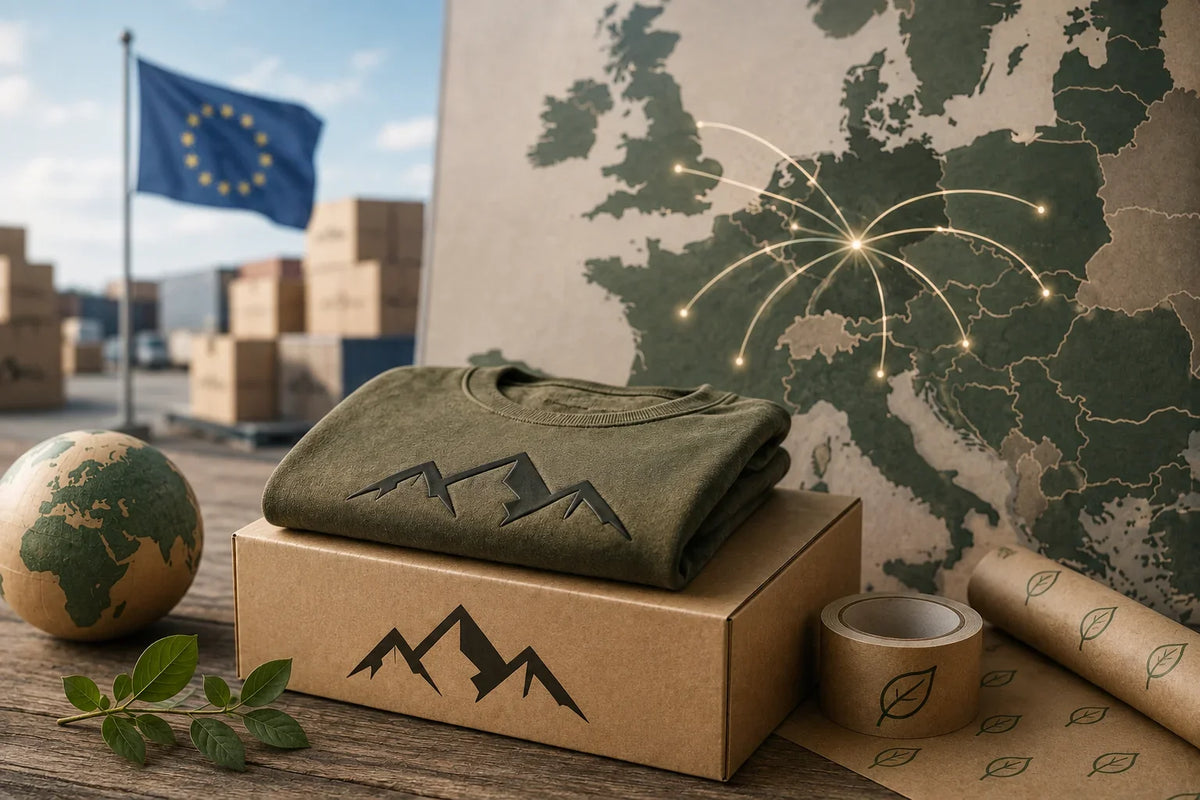
New EU Packaging Law 2026: Why We at Crewild Must Re-evaluate Our Shipping to Europe
Packaging Act - Europe is supposed to become simpler. Or at least one would think so.
The new Packaging Act - A common internal market, the free movement of goods, and an online shop that can reach customers in Germany, Austria, France, Italy, or the Netherlands alike.
However, with the new European packaging regulation, PPWR – Packaging and Packaging Waste Regulation (EU) 2025/40, a new rule is being introduced that can pose significant challenges for small and medium-sized online retailers in particular.
The regulation already entered into force in 2025 and has been applicable since August 12, 2026.
At Crewild, we expressly support the goal: less packaging waste, better recyclability, fewer unnecessary packages, and a more sustainable circular economy.
However, the practical implementation has another side.
Because anyone selling directly to end customers in other EU member states as a German online shop can become responsible for the packaging there themselves.
And that is exactly what could lead us to have to re-evaluate our current delivery area within Europe.
What changes with the PPWR?
The new EU Packaging Act is intended to harmonize existing regulations more strongly. It fundamentally applies to packaging placed on the market within the European Union.
This does not just include product packaging.
Shipping cartons, shipping bags, and other packaging components may also be affected.
One point is particularly important for e-commerce:
If a company from an EU member state sells directly to an end customer in another member state, this company may be considered a so-called "producer" within the meaning of extended producer responsibility (EPR) there.

This does not only affect large international corporations. Small and medium-sized online shops can also be affected in principle.
A Crewild shirt on its way to Austria
Let's take a very simple example.
A customer from Austria orders an individually designed T-shirt via our Crewild online shop.
We produce or customize the product and ship it directly from Germany to the Austrian end customer.
The shipping carton or bag is subsequently disposed of in Austria.
As a result, the packaging waste does not end up in Germany, but in Austria.
This is exactly where the Packaging Act and the principle of extended producer responsibility come in: the costs for collection and recycling are generally to be borne where the packaging is likely to become waste.
For Crewild, this can mean that in addition to German obligations, additional obligations arise in Austria.
The same principle can apply to direct deliveries to, for example, France, Italy, Spain, Belgium, or other EU member states.
One shop – many national obligations
And this is exactly where the problem for European online shops begins.
Because an EU regulation unfortunately does not automatically mean:
Register once and then sell to the entire EU without any problems.
Extended producer responsibility continues to be organized in the respective member states.
Anyone who regularly sells directly to end customers in several EU states must therefore check which registration, reporting, participation, and, if applicable, authorization requirements exist in the respective destination country. Can also be read here!
As a result, numerous national compliance processes can arise from a single European online shop.
For a large company with its own legal and compliance department, this may be manageable.
For smaller shops, however, the effort is considerable.
Additional authorized representatives may be required
Particularly critical is the obligation for so-called EPR authorization.
The packaging law PPWR stipulates for certain cross-border constellations that a company must appoint an authorized representative for extended producer responsibility in the respective other member state.
This representative must be based there and assumes certain obligations of the company.
This may result in more than just one-off registration costs.
In addition – depending on the respective country and its system – there are, for example:
- Registration and administrative costs,
- Costs for EPR or recycling systems,
- Remuneration of an authorized representative,
- Regular volume reporting,
- Documentation and reporting effort,
- Internal or external compliance costs.
And possibly for several countries in parallel.
The economic problem: 20 packages can suddenly become expensive
For Crewild, a very practical question therefore arises.
What happens if, for example, we only receive 20 or 30 orders per year from a specific EU country?
The actual packaging consumption is minimal.
The fixed administrative costs can still arise.
If registrations, service providers, authorized representatives, and ongoing reports are required for a few hundred euros in sales, cross-border sales can quickly become economically unattractive.
In our view, this is one of the most problematic aspects of the new regulations.
Because sustainability should not lead to small companies effectively being discouraged from using the European internal market.
Do we have to limit our delivery area?
This is exactly the question many smaller European online shops have to ask themselves now.
We at Crewild are therefore also checking to which countries direct shipping to end customers remains economically and administratively sensible in the future.
One possible consequence could be to initially concentrate the delivery area on countries where there is sufficient turnover to justify the additional costs and administrative effort.
However, that would be a paradoxical development.
The European internal market is intended to facilitate trade within Europe. At the same time, additional national registration and compliance obligations could lead to smaller retailers supplying fewer countries.
B2B is also not automatically excluded
For Crewild, one more point is important.
We often sell Corporate Fashion, teamwear, and individually designed clothing to companies, clubs, teams, or organizations.
One might therefore assume that only classic B2C deliveries are affected.
It is not quite that simple.
The PPWR does not define an end user exclusively as a private consumer. A commercial end user can also fall under this definition if they do not re-supply the delivered product to the market in the form received.
A delivery of 50 customized Crewild hoodies to a company to equip its employees can therefore be judged differently than a delivery to a retailer who subsequently resells the goods.
For us, this means: In the future, even with B2B deliveries, it must be examined more closely who receives the goods and what happens to them afterward.
And the packaging itself is changing too
The PPWR deals not only with registration and financing.
Europe generally wants to reduce packaging and make it more recyclable.
Particularly interesting for e-commerce is the so-called "empty space ratio."
By 2030 at the latest, e-commerce packaging, among other things, must be designed so that the empty space ratio is a maximum of 50 percent.
A small T-shirt in a huge shipping carton should therefore increasingly be a thing of the past.
We at Crewild believe this approach makes absolute sense.
Textiles, in particular, can be shipped in a relatively space-saving manner. Appropriate box sizes, shipping bags, and as little unnecessary filler material as possible reduce material consumption and, at the same time, transport volume.
Sustainability and economic efficiency can fit together very well here.
Sustainability yes – but please with a sense of proportion in bureaucracy
The basic idea of the new EU packaging regulation is correct.
Less waste, more recyclable packaging, and clear responsibility for those who place packaging on the market are sensible goals.
However, it becomes problematic where a small online retailer has to put in a disproportionately large amount of administrative effort for a few shipments to another EU country.
A European internal market should enable small and medium-sized enterprises, in particular, to reach customers across Europe without complications.
If, on the other hand, a shop requires different registrations, reports, systems, and authorized representatives for numerous countries, a new market entry barrier is created.
And that is exactly why we at Crewild will also check our European delivery countries.
Not because we want to work less sustainably.
But because sustainability, economic action, and practicable bureaucracy must fit together.
What does this mean for Crewild customers?
For customers in Germany, little will change initially.
For deliveries to other EU countries, we will gradually check which regulatory requirements exist and in which markets shipping can continue to be sensibly offered.
Our goal remains clear:
Individual corporate fashion and teamwear should be available as easily, sustainably, and Europe-wide as possible.
But at the same time, Europe must ensure that sensible environmental legislation does not turn into a bureaucratic obstacle for smaller companies and European online trade.
Because less packaging makes sense.
Less European trade due to more bureaucracy, however, should not be the result.
Official basis: EU Regulation 2025/40 – PPWR · EU Commission Guidelines from June 2026 · European Commission FAQ on the PPWR
CREWILD is backed by Time Of Vibes UG (limited liability), based in Munich. From the first idea and design to production and delivery, you have a personal contact person. We produce predominantly in Europe and deliver your individual collection across Europe.